Orthopaedic Associates of Zanesville
Bone and Joint Clinic

National Nutrition Awareness Month

Monday, March 25th, 2013

Soccer moms and dads out there know it is tough to be in two places at once and it is even tougher to eat healthy on the run. As part of National Nutrition Awareness Month, we want to share some tips for how to make the right choices on the go, because diet and exercise are key to healthy bones and joints.

The Academy of Nutrition and Dietetics put together a list of 30 tips. Here are our 10 favorites:

  • Pull the “pack-mule.” Make sure your purse, briefcase or backpack is always packed with snacks-on-the-go, such as: peanut butter and crackers, granola bars, a piece of fresh fruit or trail mix.
  • Plan ahead and consider what options will be available. Choose carryout restaurants with variety to give yourself a better chance of picking a healthy meal.
  • Practice portion control by ordering the regular or child-sized meal. The words “Biggie Size” are not your friend.
  • Be picky when you order. It is okay to ask for a side salad instead of French fries or to order light mayo or sauces on the side.
  • Limit alcohol consumption as it not only impairs your thinking and motor skills but also increases appetite.
  • Add as many veggies as you want. Tomato, lettuce, peppers or other vegetables can add nutritional value to your sandwich.
  • Share a regular order with a friend if you indulge in unhealthy food like French fries.
  • Be weary of jumbo-sized breakfast foods like muffins and bagels. They can often contain more than twice the fat and calories of the regular size.
  • Keep healthy lunch options in your desk, such as fruit, peanut butter, soup, or tuna.
  • Plan your meals and track your food intake throughout the day. If a fast-food dinner is on the horizon, have a lighter lunch.

List courtesy of the Academy of Nutrition and Dietetics, with help from “Finding Your Way to a Healthier You,” the U.S. Department of Health and Human Services and the U.S. Department of Agriculture.

To see the full list of 30 healthy eating on-the-run tips, and more nutritional information, please visit the Academy of Nutrition and Dietetics website.

Keep in mind, these tips can help you lead a healthier life, but please click on this link for a list of foods specifically designed to strengthen bones and joints.

Got Calcium? Hopefully Not Too Much

Monday, March 11th, 2013

Remember that legendary advertising campaign? “Milk; it does a body good.” Well, that tagline is code for: “Calcium; it does a body good.” Calcium and Vitamin D are both critical to building strong bones, but a new study shows overloading on calcium supplements could actually be harmful.

The average person ingests enough calcium in their diet to avoid bone deterioration from deficiency. This level is about 600 milligrams per day. But recommendations indicate most adults should now target roughly 1,000 milligrams per day, with teenagers and men and women 50 years or older requiring 1,200-1,300 milligrams.

If you or a loved one is having trouble getting enough calcium from food, calcium supplements can be used in moderation. However, American Bone Health cautions that 500 milligrams is likely the maximum amount needed as a supplement to a person’s diet.

Orthopaedic Associates of Zanesville recommends revisiting your diet, as simple adjustments can make a big difference. Below is a list of food to add to your shopping list along with its average calcium serving (courtesy of Go Ask Alice!):

  • Milk: 300 mg (8 oz)
  • Yogurt: 300 mg (8 oz)
  • Cheddar cheese: 303 mg (1.5 oz)
  • Tofu: 258 mg (1/2 cup)
  • Chinese cabbage: 239 mg (1/2 cup)
  • White beans: 113 mg (1/2 cup)
  • Pinto beans: 45 mg (1/2 cup)
  • Red beans: 41 mg (1/2 cup)

Our friends at American Bone Health also offer the Calcium Rule of 300 for maintaining a healthy calcium intake.

Watch How We Can Help You

Monday, February 25th, 2013

Orthopaedic Associates of Zanesville is proud to help our patients “get back at it.” In 2011, we released a series of videos highlighting three of the most common ailments we treat and procedures we perform: wrist injuries, tendonitis and hip replacement surgery. We encourage you to watch these videos by clicking on the links below, because if you haven’t seen them – they’re new to you!

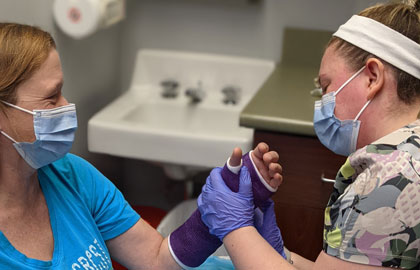
  • Wrist injuries: Wrist injuries are the most common ailment we treat at OAZ, particularly broken wrists and carpel tunnel syndrome. Treatments options include casting, setting the fracture or surgery. As we discussed in an earlier blog post, carpal tunnel syndrome results from pressure on the median nerve and often causes numbness, tingling, night pain and weakness in the hand.
  • Tendonitis: Tendonitis occurs when small tears form in a tendon. It is a common injury often associated with weight lifting. Biceps tendonitis is caused by repetitive elbow flexion while triceps tendonitis is the result of repetitive and forceful elbow extension.
  • Hip Replacement: Hip replacement is necessary when the covering allowing a joint to move freely is worn or damaged. Often categorized as “bone-on-bone friction,” the result is a loss of movement and a decreased ability to bear weight, which leads to surgery.

At OAZ, our primary goal is to educate our patients on how to make the right choices for their bodies and their bones. If you or a loved one has suffered an orthopaedic injury, please schedule an appointment with one of our physicians by visiting our website or calling 740-454-3273.

No Bones About It: Bone Facts

Monday, February 18th, 2013

Bones are our business. We spend our lives treating orthopaedic injuries and counseling patients on best preventative and rehabilitation practices. Now, we want to make our patients know more about their skeletal systems, because being in tune to your own body makes it easier to recognize and prevent common injuries.

Please enjoy this list of bone and fracture facts:

Did you know: Bones are made up of 50 percent water and 50 percent solid matter.

Did you know: Only 35 percent of Americans consume the recommended daily allowance of calcium (according to American Bone Health).

Did you know: More than 6.3 million fractures occur in the United States each year (American Academy of Orthopaedics).

Did you know: Fractures account for 16 percent of all musculoskeletal injuries in the United States annually (American Academy of Orthopaedic Surgeons).

Did you know: The femur is the largest bone in the human body (and part of the leg).

Did you know: The smallest bone in the human body is the stapes. Found in the ear, the stapes is the size of one grain of rice.

Did you know: Osteoporosis is the most common bone disease with nearly 40 million Americans already suffering or at risk because of low bone mass.

At OAZ, our primary goal is to educate our patients on how to make the right choices for their bodies and their bones. If you or a loved one has suffered an orthopaedic injury, please schedule an appointment with one of our physicians by visiting our website or calling 740-454-3273.

Healthy Weight Week

Monday, January 21st, 2013

National Healthy Weight Week is underway and celebrates 20 years of promoting healthy diet-free living habits. While the focus is on women’s eating habits, Orthopaedic Associates of Zanesville wants to stress the importance for everyone to enjoy a healthy and balanced diet.

An eating disorder can cause bones to weaken and show marked deficits in bone mass, especially if the disorder begins in the teenage years. You might be wondering, what is anorexia? Or, what is bulimia? These are the two most common eating disorders, with anorexic patients depriving themselves of food and bulimic patients overeating and binging without digesting and absorbing food’s nutrients.

Anorexia and other eating disorders affect up to 1 percent of college-age women. Bone loss can be significant and can be detected after just six months of having the disease. The National Association of Anorexia Nervosa and Associated Disorders (ANAD) offers treatments options and support groups and is a good resource if you know someone battling the disease.

At OAZ, our primary goal is to educate our patients on how to make the right choices for their bodies and their bones. If you or a loved one has suffered an orthopaedic injury, please schedule an appointment with one of our physicians by visiting our website or calling 740-454-3273.